The light starts a reaction—it does not simply dry the filling
Composite resin is a tooth-colored material used to restore damaged areas. Light-cured versions contain an ingredient that starts a reaction when exposed to suitable light. It is called a photoinitiator: think of it as a small starting switch within the material. When activated, it sets off a reaction that links the material’s molecules together.[1][2]
This process is called photopolymerization, or, more simply, light curing. It is different from drying something wet with moving air. After the resin has been placed, this light is used to harden it. This step should not be mistaken for disinfecting the mouth.[1]
Why blue light?
The important question is not whether the color looks right, but whether the light emitted by the device matches the light the material responds to. Common photoinitiators respond to light in the blue region. Materials containing different ingredients may need a different range of light. “Wavelength” is one way of describing these differences.[2]
Widely used modern LED curing units mainly operate in the visible-light range. Blue light should not automatically be confused with ultraviolet light. But visible light is not necessarily safe to look at directly. The light can harden a filling and still require appropriate eye protection.[2][4]
Why the timing may differ from one filling to another
You may wonder why the light was used briefly last time but several times today. The type and shade of material, the thickness of each layer, and the distance and angle between the tip and the filling all matter. The starting point is the manufacturer’s instructions, so there is no single timing rule for every filling.[1]
The output displayed on a device is not necessarily the amount of light that reaches the resin. The shape and position of the beam can also make delivery uneven across a single area. A review of curing units explains how these differences can lead to uneven curing. That is why counting the seconds alone cannot tell you how thoroughly a filling has cured.[3]
Is stronger light, used for longer, always better?
Adequate curing matters, but using intense light for longer is not automatically a better approach. Heat generated during exposure also needs to be considered. The FDI World Dental Federation cautions that short exposure times with high-output units are not suitable for every material.[1]
You do not need to memorize the numbers on the device. What helps is telling the dental team if you feel heat or discomfort rather than enduring it silently. Agree on a signal before treatment—such as raising a hand to ask for a pause—instead of moving your head suddenly.
The orange shield is there to protect your eyes
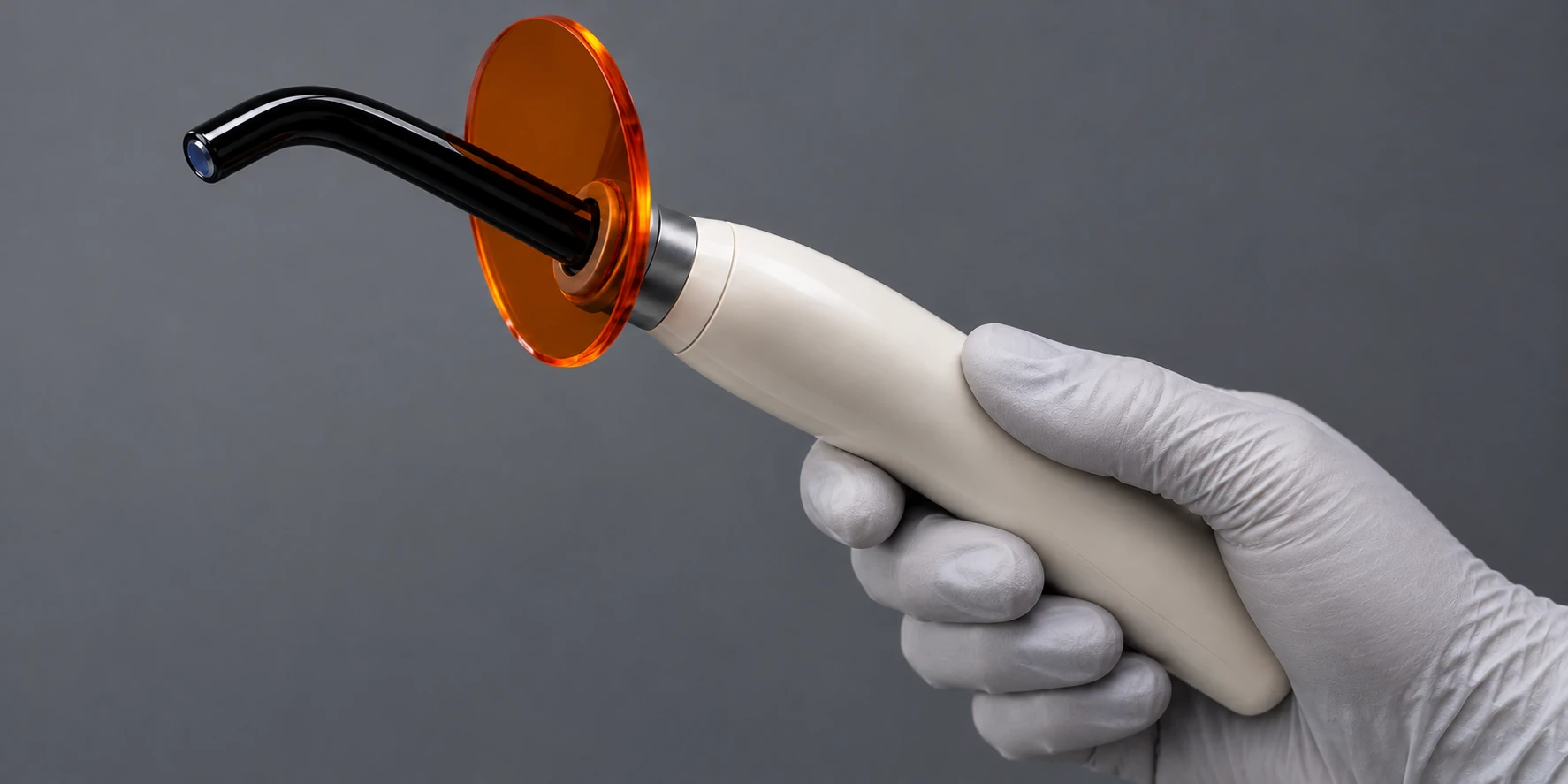
The orange shield on a curing light and dedicated protective glasses do more than reduce glare. They must be selected to filter the light produced by that particular device. The American Dental Association advises using protection appropriate for equipment such as curing lights and checking the relevant product instructions.[4]
Ordinary glasses or similarly colored sunglasses cannot be assumed to provide the same protection. Use the protection supplied by the dental team as directed, and do not deliberately look into the light-emitting tip. A shield’s presence alone is not enough; its position and correct use matter too.[2][4]
Does proper curing guarantee a long-lasting filling?
Proper light curing is an important part of a composite restoration, but it cannot guarantee the success or lifespan of treatment on its own. The sources used here are not clinical trials showing that a particular device makes every filling last a set number of years longer. This explanation draws on reviews of materials and light-curing principles, together with professional guidance.[1][2][3]
The next time you notice the blue light, you can recognize the step: the filling material is being hardened. Rather than trying to watch the instrument during treatment, ask before or afterward, “What material are you using?” or “How should I use this shield?” Understanding an unfamiliar step can make the experience feel a little less mysterious.
Research and institutional sources
- FDI World Dental Federation. Intraoral Light Curing of Resin Based Material Statement. Adopted September 2021.View source ↗Professional policy statement: matching materials and wavelengths, and managing layer thickness, exposure time, distance and heat.
- Hasanain FA, Nassar HM. Utilizing Light Cure Units: A Concise Narrative Review. Polymers (Basel). 2021;13(10):1596. doi:10.3390/polym13101596. PMID:34063428.View source ↗Narrative review: composite curing, LED wavelengths and protective equipment. PubMed abstract and figure captions, plus indexed PMC text, checked; direct full-text access was restricted.
- Price RB, Ferracane JL, Shortall AC. Light-Curing Units: A Review of What We Need to Know. J Dent Res. 2015;94(9):1179–1186. doi:10.1177/0022034515594786. PMID:26156516.View source ↗Review: the difference between device output and light reaching the material. Publisher abstract checked; full text requires a subscription.
- American Dental Association. Eye Safety in the Dental Office.View source ↗Professional safety guidance: equipment-specific eye protection, including curing lights. No publication or revision date is stated on the page.
Bracketed numbers in the text link to these sources. This article provides general health information; individual diagnosis and treatment plans are determined after a clinical consultation.