Pain on day three does not always mean dry socket
You may feel more pain and swelling on the second or third day than on the day of the extraction. University College London Hospitals (UCLH) explains that both can increase during the first 72 hours. Recovery also depends on how complex the surgery was.[1]
The day the pain occurs cannot tell you its cause. Notice whether pain that was improving has started to worsen, or whether your prescribed medicine is no longer controlling it. Contact the dentist who performed the extraction if this happens.[2]
Why does losing the blood clot hurt?
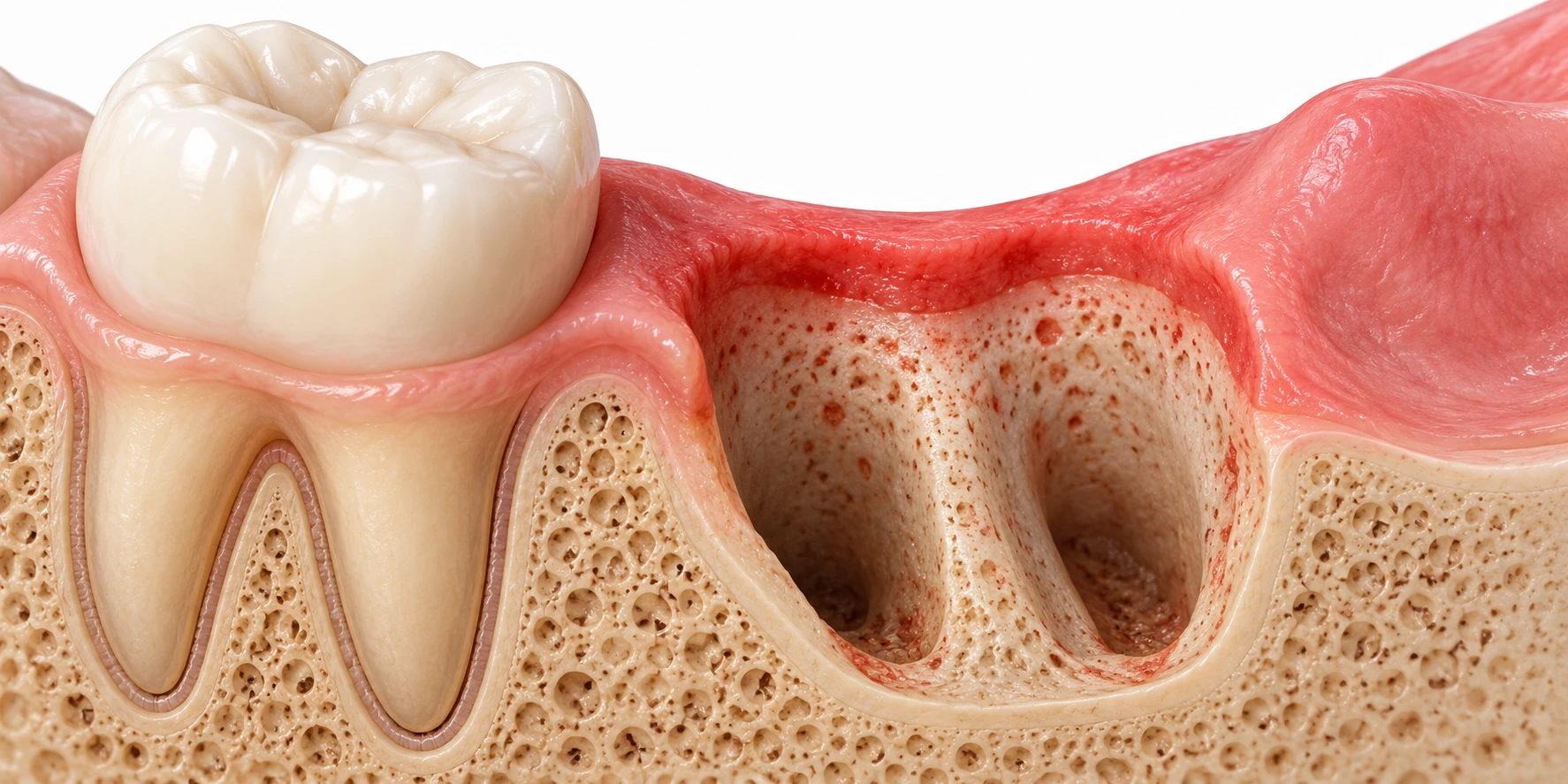
After a tooth is removed, blood normally clots in the empty socket. This clot covers and protects the underlying bone and nerve endings. If it comes away too early or fails to stay in place, the exposed bone can become very painful. This is called dry socket. The American Dental Association (ADA) describes it as the exposure of bone and nerves after the clot is displaced.[3]
The cutaway above shows a lower wisdom-tooth socket with its protective clot missing and the bony walls exposed. It illustrates the anatomy; your wound will not necessarily look like this in a mirror.
Pain toward the ear or a fever needs attention
Dry socket pain can spread toward the ear or temple on the same side, sometimes with an unpleasant taste or smell. However, pain or odor alone cannot reliably distinguish dry socket from an infection. Mayo Clinic advises contacting a dentist if pain is new or getting worse.[2]
Fever, pus-like discharge or marked swelling with pain also needs assessment for infection. Cambridge University Hospitals lists these as reasons to seek advice after an extraction. Symptoms can overlap, so do not try to settle the diagnosis at home.[4]
What to tell your dentist
Describe how the pain has changed: “I had a wisdom tooth removed three days ago. It hurts more today than yesterday, and the medicine is not helping much.” Mention the extraction date, when the pain worsened, where it hurts, what medicine you have taken and whether you have a fever or swelling.[5]
The UK's National Health Service (NHS) advises urgent dental care for severe pain or swelling not controlled by painkillers, or bleeding that will not stop. Pain with a fever or feeling unwell also warrants a call rather than waiting for your next appointment.[6]
How is dry socket treated?
Your dentist asks about your symptoms and examines the socket for the clot and exposed bone. An X-ray may be needed to check for other causes.[5]
Dry socket treatment can include cleaning the socket, placing a medicated dressing and prescribing pain relief. Depending on how the wound heals, you may need further visits to change the dressing.[3]
Do not scrape inside the socket or put medicine into it yourself. Follow your dentist's instructions on when and how to clean inside the socket.[1][5]
What can a collagen plug do?
A collagen plug is an absorbable collagen material that a dentist can place in an extraction socket. When appropriate, the dentist may place a collagen plug to help control bleeding, stabilise the blood clot and support wound healing. It is not essential for every extraction; the dentist decides whether to use it based on the wound.[7]
Protect the wound while it heals
On the day of the extraction, avoid forceful rinsing, repeated spitting and touching the socket with your tongue or fingers. Gentle rinsing can generally begin after 24 hours, following your dentist's instructions. Take care not to disturb the wound when brushing nearby teeth.[1]
Choose soft foods that are easy to chew. Avoid hard foods and items such as nuts that can lodge in the wound, and do not smoke. Pain can worsen even when you follow the care instructions. If that happens, contact your dentist rather than putting up with it or taking extra medicine on your own.[6]
Research and institutional sources
- University College London Hospitals NHS Foundation Trust. Dental extractions: post-operative instructions. Updated 6 February 2025.View source ↗Hospital guidance on early pain and swelling and care that protects the blood clot.
- Mayo Clinic Staff. Dry socket: Symptoms and causes. 18 July 2023.View source ↗Patient guidance on dry socket symptoms and when new or worsening pain needs assessment.
- American Dental Association. Dry Socket. MouthHealthy.View source ↗Patient guidance on loss of the clot, exposed bone and nerves, and dental treatment. No revision date is displayed.
- Cambridge University Hospitals NHS Foundation Trust. Surgical extraction of teeth. Version 6. Approved 20 November 2023.View source ↗Hospital guidance on fever, discharge, pain and swelling that may indicate infection after an extraction.
- Mayo Clinic Staff. Dry socket: Diagnosis and treatment. 18 July 2023.View source ↗Patient guidance on examination, tests when needed, socket cleaning, dressings and symptoms to report.
- NHS. Wisdom tooth removal. Last reviewed 12 June 2024.View source ↗Advice on food, oral care and symptoms requiring urgent dental attention after wisdom tooth removal.
- Kim JW, Seong TW, Cho S, Kim SJ. Randomized controlled trial on the effectiveness of absorbable collagen sponge after extraction of impacted mandibular third molar: split-mouth design. BMC Oral Health. 2020;20:77. doi:10.1186/s12903-020-1063-3.View source ↗Describes the supportive roles of absorbable collagen in hemostasis, clot stabilization and wound healing. This small trial analyzed 31 patients; its findings do not guarantee the same outcome for every extraction.
Bracketed numbers in the text link to these sources. This article provides general health information; individual diagnosis and treatment plans are determined after a clinical consultation.